
Capitalism Without Competition Is Oligarchy
America’s problem is not capitalism – it’s the corruption of competition

For decades, Americans were told that globalization and free markets would deliver broadly shared prosperity. Instead, many saw stagnant wages, hollowed-out communities, and a growing concentration of wealth and power. The backlash was inevitable. But the real failure was not capitalism itself. It was the corruption of competition and the establishment’s generations-long indifference to the working class it left behind. That disregard didn’t just crater trust in institutions; it fueled populist backlash across the political spectrum, with anti-establishment anger now reshaping American politics.
Two truths define the American economic dilemma. First: competitive capitalism remains history’s most powerful engine for wealth creation, driving greater aggregate prosperity over the past two centuries than perhaps any other economic system. But averages are dangerous fictions; a man can easily drown in a lake that is, on average, two feet deep.
Second: the laissez-faire ideology that achieved near-religious status in recent decades has mutated into something closer to crony capitalism than genuine market competition.
Free markets do not emerge naturally; they are enforced political constructs. If markets work, it is because rules make them work. In American political rhetoric, faith in markets was often distorted into the fiction that the government’s best role was total noninterference. But Adam Smith’s real insight was not that markets should be left alone, but that competition disciplines self-interest into socially productive outcomes. Properly structured, the system aligns private ambition with public benefit: entrepreneurs profit by creating products and services consumers prefer over competing alternatives. It is the dynamic of competition that results in consumer surplus.
A fundamental principle in Smith’s model is that entrepreneurs must play fairly under a set of transparent, agreed-upon rules. Ironically, our crony capitalism model depends on the precise opposite of what Smith had in mind: unfairly advantaged producers raising structural obstacles to quash the very competition that benefits consumers. America’s most powerful corporations no longer win by competing. They win by rewriting the rules of competition. This is what drives today’s crisis of democratic legitimacy.
Markets fail in predictable ways. That is why government intervention is not a betrayal of capitalism, but often a prerequisite for making it work. The most common market failures are:
Information asymmetry. Markets break when participants operate with radically unequal information. That is why institutions like the FDA, FTC, and SEC exist: to reduce deception, protect consumers, and preserve trust.
Externalities. Firms maximize profits by widening the gap between revenues and costs. But when some costs—such as carbon emissions—are shifted onto society, markets stop pricing reality. This is not just a moral failure—it is an economic distortion. If firms were required to account for external costs, capitalism’s innovation engine would race to solve the problem. In such a system, the winning firm would be the one that delivers value with the lowest real social cost. Properly designed regulation could align capitalist incentives with climate solutions.
Underinvestment in public goods. Some goods are chronically underprovided by markets because their benefits are shared too broadly to be captured privately. Infrastructure, clean air and water, parks, national security, emergency services, and public education all fall into this category. Few public investments have delivered returns as consistently as education, which produces more productive citizens and reduces long-term social costs.
A healthy capitalist system should also serve the public good. But this balance collapses when dominant firms evade the costs they impose on society while simultaneously shaping the political rules meant to constrain them. At that point, the interests of economic elites diverge from those of the public—even if GDP keeps rising. Left unchecked, that divergence only widens. If capitalism becomes merely a mechanism for incumbents to privatize gains while socializing costs, collapse is not a bug. It is the logical endpoint. After all, what good is bragging about a rising GDP while so many of our citizens are drowning?
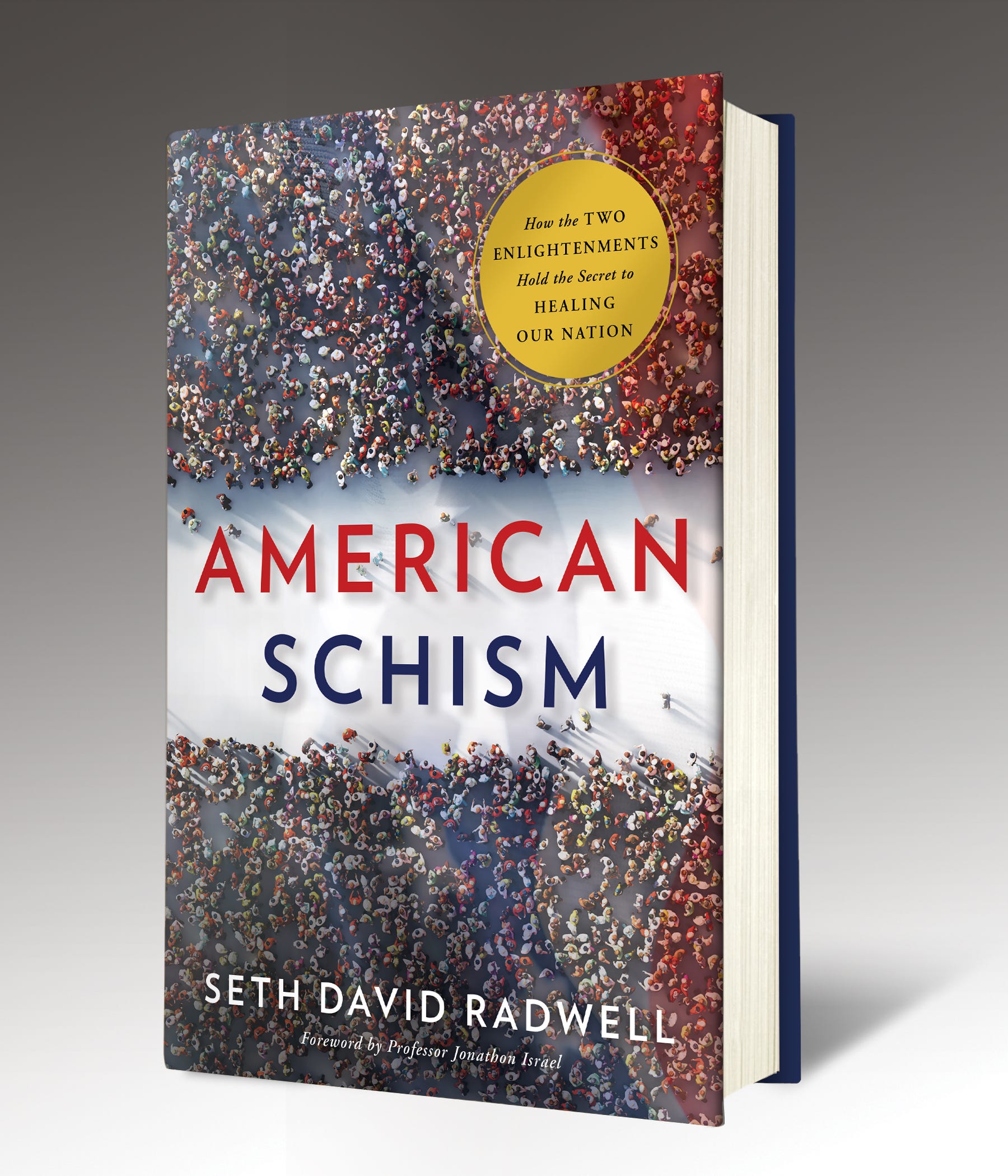
Radwell is the author of “American Schism: How the Two Enlightenments Hold the Secret to Healing our Nation” winner of last year’s International Book Award for Best General Nonfiction. He serves on the Advisory Councils at Business for America, RepresentUs, and The Grand Bargain Project, and is a frequent contributor as a political analyst, and speaker within both the business community and on college campuses both in the U.S. and abroad. This is the sixth entry in a 10-part series on the American Schism in 2025.
It’s also “representation without taxation” for oligarchs and their corporations, which, as corporate persons, enjoy most of the rights, privileges and rewards of citizenship but few, if any, of the duties, obligations or taxes required of citizens, especially when it comes to their private data, which the oligarchs gained access to through regulatory capture, which effectively reversed traditional eminent domain by allowing the government, ISPs and corporations access to copy, sell, resell, and so on, your data, without traditional eminent domain’s reimbursement for what the government seized and shared with its oligarchs, legally.
I agree with what you say. In addition, this severe version of “socializing risk and privatizing profits” or “corporate welfare” is actually “representation without taxation” — the opposite of the American Revolution’s rallying cry — for oligarchs.
Just as the Lenape didn’t know what they traded away to the Duch East India Company, we don’t know what’s going on with our data or who or what is harvesting, selling and reselling it, which in many cases is our intellectual property, which, along with our personal data, is our private property, and it’s also the labor that created and posted it online without compensation from these corporations, which pay no taxes or gift taxes on this effectively nationalized “private” personal data, which makes all the oligarchs’ profits “ill-gotten gains,” but hey, who’s even noticing any of this unwitting labor?
After all, even if it might be legally categorizable as “coerced data,” it still is probably legal, especially when we live in an era where “those who obey best are least aware they’re obeying at all” is as true as ever.
It was all so thorough, thought-through, unexpectedly unopposed, and long in the making, perhaps.
Maybe we were boiling frogs for snakes while being slowly boiled ourselves, oblivious to our own capture and until we were cooked.
To be fair, ethical or not, all parties are behaving with economic rationality in a system designed to serve its winners with winner-take-all rewards.
It’s not sustainable, is the problem, without routine bailouts, but they, too, entrench the oligarchy further, each time. Historically speaking, that is, by my best estimation.
Absolutely on-target! What is undermining our economy is the evolution of Mergers and Acquisitions, Private Equity and Hedge Funds creating oligopolies by buying competitors as a strategy to permit increased price as a primary means for growth, where customer or employee satisfaction has no leverage. Some form of government regulation or legislative guardrails are necessary to enforce anti-trust protection of competition.